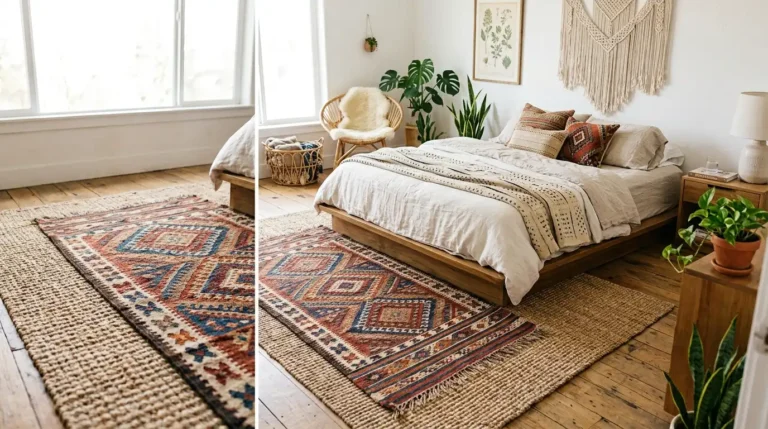

How to Choose the Right Rug Size for Your Bedroom (With Diagrams)
Getting the bedroom rug size wrong is one of those mistakes you feel every single morning. You step out of bed, your feet hit cold floor, and that rug you spent good money on sits a foot too far away to matter. It happens constantly, and it is almost always a sizing problem.
The frustrating part? Most rug guides throw a list of dimensions at you and call it done. But the right rug size depends on your bed, your room layout, and where you actually stand when you get up. A 5×8 that works fine under a queen in a big room looks ridiculous in a tight 10×12.
This guide breaks it down by bed size, room shape, and placement style, with diagrams so you can see exactly how each setup looks before you order anything. No more guessing, no more returns.
The 18-Inch Rule That Fixes Most Rug Mistakes
Here is the simplest bedroom rug rule worth memorizing: your rug should extend at least 18 inches beyond each side of the bed where you step out. That is it. Eighteen inches gives you enough soft landing space to plant both feet on fabric instead of bare floor.

Measure from the edge of your mattress outward. If you have nightstands, decide now whether you want the rug under them or stopping just before. Either looks fine, but the 18-inch clearance from the mattress edge is the part that actually matters for comfort.
Start there, and most other sizing decisions fall into place on their own.
Full Rug Under the Entire Bed Frame

When the rug sits fully under the bed with equal overhang on all exposed sides, the room instantly feels pulled together. This is the most grounding layout because the rug acts like a frame around the bed, anchoring everything in place.
For this to work, you need a rug large enough to extend at least 18 inches past the sides and foot. With a queen bed, that usually means an 8×10 or 9×12. With a king, you are almost always looking at a 9×12 as the minimum.
Tuck about 8 to 12 inches of the rug under the headboard wall. It does not need to go all the way to the wall. Just enough to stay in place and look intentional.
Two-Thirds Placement for Mid-Size Rooms

A rug that covers roughly the lower two-thirds of the bed works well in rooms where a full-size rug would crowd the space. You slide the rug so it starts about one-third down the mattress and extends past the foot of the bed. Both sides still get coverage for stepping out.
This layout is practical for small bedrooms where wall-to-wall rug coverage would make the floor feel heavy. It leaves breathing room near the headboard and door, while still giving you the softness where your feet actually land.
A 6×9 rug handles this nicely under a queen. For a king, step up to an 8×10.
A 5×7 under a queen barely peeks past the mattress edges. Your feet miss it every morning and the rug looks like an afterthought floating in the middle of the room.
A 6×9 in two-thirds placement catches your feet on both sides, frames the lower half of the bed, and leaves floor showing near the headboard for balance.
Runners on Both Sides of the Bed

Place one runner along each side of the bed, starting roughly at the pillow line and ending at or just past the foot. This two-runner setup gives you a soft step-out zone on both sides without needing a single large rug.
Standard runner sizes for bedrooms are 2.5×8 or 2.5×9. Keep them centered on where your feet actually land, not pressed against the bed frame. Leave about 4 to 6 inches of floor between the runner and the side of the mattress so the layout feels relaxed, not cramped.
This works especially well in narrow rooms where a wide rug would bump into dressers or closet doors. I have used this setup in a rental where the bedroom was barely 10 feet wide, and it solved the cold-floor problem without eating up the walking path.
Accent Rug at the Foot of the Bed

I have always liked this placement in rooms that already feel cozy and layered. A small accent rug at the foot of the bed, roughly 3×5 or 4×6, sits horizontally across the foot and gives you a landing spot when you sit on the edge to put on shoes or fold laundry.
Center it so it extends evenly past both sides of the mattress by a few inches. If you have a bench at the foot of the bed, let the front legs of the bench sit on the rug. That small overlap ties the two pieces together.
This is a low-commitment option if you are testing a color or pattern before buying a larger rug. It is also the easiest to swap out with the seasons.
💡 Quick Tip
Use a rug pad underneath accent rugs on hardwood floors. Without one, a small rug at the foot of the bed slides every time you step on it. A non-slip pad costs a few dollars and saves you the daily shove-it-back-into-place routine.
King Bed Rug Sizes That Actually Work

People undersize king bed rugs more than any other bed type. A king mattress is 76 by 80 inches on its own, so a rug that felt huge in the store can look shrunken once it is under the bed. Most people need to go bigger than they think.
For full placement under a king: a 9×12 is the standard fit. It gives you about 22 inches of rug on each side and roughly 24 inches past the foot.
For two-thirds placement: an 8×10 works, positioned from mid-bed to past the foot. For runners: two 2.5×9 runners, one on each side. Pick the layout that fits your room size, not just your bed size.
Queen Bed Rug Size Guide

A lot of guides say a 5×8 is fine for a queen bed. It is not. A queen mattress is 60 by 80 inches, and a 5×8 barely gives you 5 inches of rug past each side. That is enough to graze with your toes, not enough to actually step onto.
The better options:
Full placement: 8×10 gives generous overhang on all sides. Two-thirds placement: 6×9 covers the lower portion well. Foot accent rug: a 4×6 laid horizontally across the bottom. Runners: two 2.5×8 rugs, one per side.
If you are working with a neutral color palette in the room, a slightly oversized rug in a warm tone like oatmeal or soft clay grounds the bed without competing with the wall color.
| Placement Style | Recommended Rug Size |
|---|---|
| Full under bed | 8×10 |
| Two-thirds placement | 6×9 |
| Foot of bed accent | 4×6 (horizontal) |
| Side runners | Two 2.5×8 |
Twin and Single Bed Rug Sizing

Twin beds sit in kids’ rooms, guest rooms, and compact studio layouts. The mattress is only 38 by 75 inches, so you do not need much rug to make a real difference. But the mistake people make is buying a tiny 2×3 mat and calling it done.
A 5×8 placed lengthwise under a twin bed gives you 18 inches on the open side and about 10 inches at the foot. That is enough to feel like a real rug, not a bath mat.
If the twin is pushed against a wall, a 4×6 works with the rug extending out on the exposed side only. For bunk beds, a 5×8 centered between the ladder side and the wall catches most foot traffic.
Twin Bed Rug Sizing Checklist
Rug Placement for a Corner Bed

Corner beds are tricky because two sides are against walls, which means only one long side and the foot are exposed. A full-size rug tucked under the bed would have half its surface hidden behind furniture and drywall. That is wasted rug.
Instead, use an L-shaped approach. Place a runner along the open side of the bed and a smaller accent rug at the foot. Or use a single 5×8 positioned so it catches the open side and wraps slightly around the foot corner.
If you are designing a small bedroom layout where the corner placement is the only option, do not force a centered rug arrangement. Work with the room, not against it. A well-placed runner looks better than a rug crammed halfway under a wall.
How Room Shape Changes Your Rug Size

A square room and a long narrow room need different rug shapes, even if they have the same square footage. In a square room (say, 12×12), a square or nearly-square rug like an 8×10 sits naturally. In a narrow room (10×14), a longer rug like a 6×9 or runners work better because they follow the room’s proportions instead of fighting them.
Keep at least 12 to 18 inches of bare floor visible between the rug edge and the walls. A rug that runs right up to the baseboards looks like failed wall-to-wall carpet, not a design choice.
Round rugs can work in bedrooms, but only with smaller beds (twins, full) in rooms that have some breathing space. Under a king or queen, round rugs rarely give you enough coverage on all sides to be practical.
Match rug shape to room shape: rectangular rug in a rectangular room.
Leave 12 to 18 inches of floor between rug edge and walls.
Do not push the rug flush to the walls. It looks unfinished.
Avoid round rugs under king or queen beds unless the room is oversized.
Bringing It All Together
Choosing the right rug size for your bedroom comes down to three things: your bed size, where your feet land in the morning, and how much floor your room can afford to cover. Start with the 18-inch rule, pick the placement style that fits your layout, and measure before you buy. A rug that fits right makes the whole room feel finished, and your mornings a little warmer. Save this guide for the next time you are shopping so you can order with confidence instead of crossing your fingers.